Blushing Brassicas
We can't get enough of it: all those beautiful autumn colors in nature! And at this time of year, of course, also the discolouration in the dewy, misty Brassica fields at our growers.

.avif)
The discolourations are caused by pigments that are present in the plants and show changes under specific circumstances. In the case of Brassica, it is mainly anthocyanin that provides the familiar intense red and purple tones at low temperatures. Fantastic colors that can be combined so beautifully in festive arrangements or cool bouquets in autumn and winter.
With the Brassica Empire series and the various specialties that are exclusively available through Evanthia, you can create a colorful range with a great appearance, Brassicas with long, sturdy stems and a harder leaf structure. In addition, Empire has better disease resistance and a strong reduction in the typical Brassica scent.
Discoloration rate
These color changes are beautiful and offer the chance to surprise your customer again and again, but they are something to take into account in your range selection. Not all varieties respond with the same intensity or speed. To give you a little more insight into this, we have divided our product range into discoloration rates: Early — Medium — Late.
For example, Brassica Empire Akilina is one of the varieties that will be the first to blush and Empire Ksenia will become discolored last. Dive into our range and discover all the different shapes (round, feathery or jagged leaves) and colors.



Save the date!
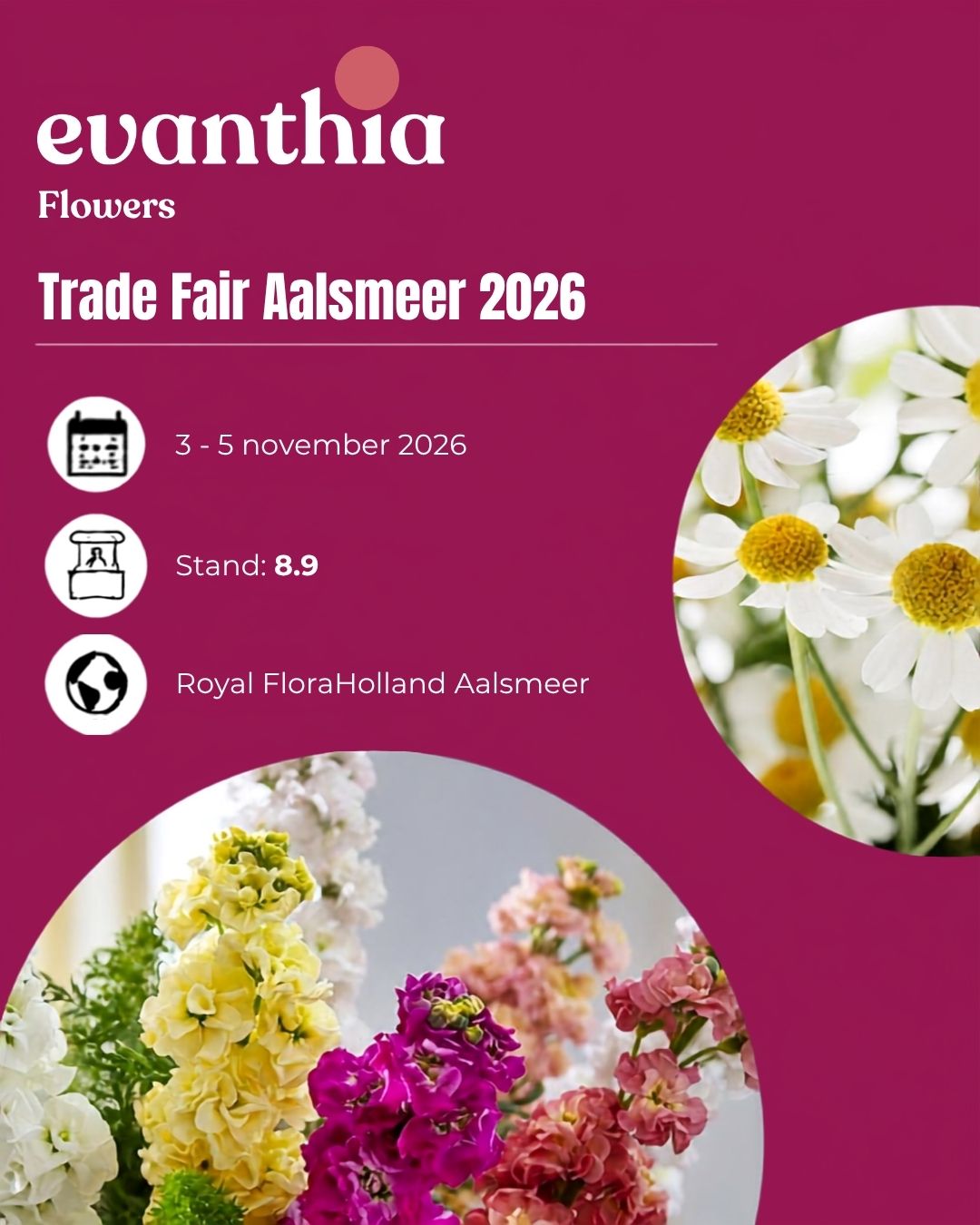
For years, the Trade Fair Aalsmeer has been considered the must-attend networking and inspiration event for the floriculture industry.
This year, the fair will take place from November the 3rd till November the 5th, 2026.
Who is the Trade Fair Aalsmeer for?
Professionals from home and abroad who visit the fair for inspiration, collaboration and market intelligence:
- Professional buyers of flowers and plants: such as exporters,
wholesale, retailers, garden centers, florists, and designers - Growers
- Suppliers and service providers within the floriculture supply chain
- Press and media
- Networkers and innovators: anyone looking to be inspired and connected by the floriculture sector

Drought-tolerant plants are becoming increasingly important for growers
Less water, same quality
In various production regions, pressure on available water resources is increasing. As a result, growers are actively seeking crops that use water more efficiently without compromising on quality, uniformity, and ornamental value.
"We observe that growers are increasingly requesting varieties that maintain stable performance under challenging conditions. This is not only due to regulations but also because their customers are more explicitly demanding it."