Dracaena fragrans 'Burley'
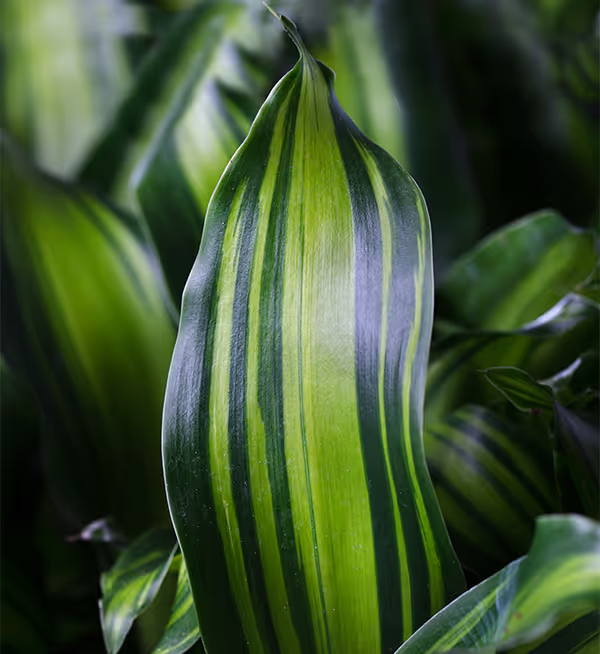
Dracaena fragrans Burley is a beautiful tropical foliage plant. In its natural environment, it produces fragrant flowers; the botanical name fragrans refers to this. As a decorative houseplant, its long pointed leaves are its most striking feature. The leaves of Dracaena Burley are arranged in a spiral and are arching, with a prominent olive-green central stripe and dark green margins. Dracaena fragrans is native to tropical parts of Africa as an evergreen perennial. There, it grows in high-altitude areas and moist tropical forests. Dracaena fragrans Burley is a spectacular plant and very suitable for brightening up shady spots in a room or office. As a bonus, the Dracaena is one of the best air purifiers. Aside from the striking color and pattern of the leaves, Dracaena fragrans Burley was selected for its robustness and resilience. It is an easy plant to grow and tolerates diverse climatic conditions. Dracaena fragrans Burley is also known as the Dragon tree. Other internationally used names for Dracaena fragrans include: Sweet-scented dracaena; Corn plant; Cornstalk plant; Cornstalk Dracaena; Dracena Fragrans; Corn Palm; Palmillo; Fortune Plant; Senjuang Wangi; Dragon Plant; Iron Plant. Evanthia has Dracaena fragrans Burley starting material available year-round, as young plants from tissue culture. Ask our team for the Dracaena cultivation manual for commercial production. View all Dracaenas in the Evanthia range.
Properties
Botanical name:
Dracaena fragrans
Dutch name:
Family:
Asparagaceae
Series:
Product group:
Dracaena
VBN code:
Status:
Product group:
Air purifying
Cultivation information
Starting material:
Young plant from tissue culture
Pot size:
cm
Stem length:
-
cm
Cultivation location:
Plant density:
/ m²
Sowing period:
Cultivation temperature:
Pot size:
cm
Potsize
50-120
cm
Ideal cultivation temperature:
16-23
°C
Growing time to young plant:
16-18
weeks
Growing time from young plant to end product:
15
-
52
weeks
USDA Hardiness zone:
10-11
Average seeds per kilo:
The information presented here is intended as a general guideline and should not be considered instructions for cultivation. Details are based on Western European climate conditions, unless specifically stated otherwise.